
 Out of stock
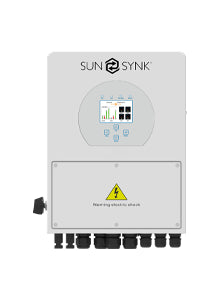
Sunsynk Sun 5K ECCO Hybrid Inverter
- Secure Checkout
- Next Working Day(Usually)
- Tracked Delivery
Sunsynk Sun 5K ECCO Hybrid Inverter
Sunsynk 5kW ECCO Hybrid Solar Inverter, 6.5kWp Dual MPPT
The Sunsynk 5kW ECCO is the larger of the two ECCO models we hold, and it is specified less for its extra 1.4 kW of output than for what sits behind it: separate essential and non-essential load outputs, a zero-export function, and the ability to take power from the grid, a generator or even a wind turbine as well as the array.
That makes it the one to reach for when a property has loads worth keeping alive in a cut and loads that can be dropped, or where generation is coming from more than one place. Up to 16 batteries can hang off a single unit, and up to 16 inverters can run in parallel on matching firmware.
ECCO 5kW at a glance
What's in the box
From the parts list in Sunsynk's ECCO SG04LP1 user manual, revision v23, the copy attached to this product. The Wi-Fi data logger and the CT sensor clamp are both included, which on most inverters at this output are bought separately.
- The 5 kW inverter with its wall mounting bracket
- Four M8 × 80 stainless steel anti-collision bolts, and two M6 × 12 mounting screws
- Data logger – Wi-Fi monitoring through Sunsynk Cloud and the mobile app
- Sensor clamp – the CT the inverter reads import and export from
- Battery temperature sensor
- Battery magnetic ring and BMS magnetic ring, for suppressing interference on those runs
- Parallel communication cable and an L-type hexagon wrench
- User manual
- Battery – chosen separately, and the cable set depends which one
- PV cable and MC4 connectors, AC cable, isolators, consumer unit protection
- Installation and the DNO application
Essential and non-essential loads
This is the feature that separates the 5 kW from the smaller ECCO in practice. The inverter has two load outputs. The essential one stays live from battery and solar when the grid drops; the non-essential one is shed. In a power cut the fridge, the boiler controls and a lighting circuit keep running while the shower and the oven do not, instead of the whole house fighting over a 5 kW budget.
Zero export is built in too, so where the DNO will not allow any power back onto the network the inverter can be set to generate for the house only.
Panels, strings and other sources
Two trackers, one string each, 13 A apiece, working from 150 V to 425 V with a 500 V absolute limit and a 125 V start-up. Maximum PV input is 6.5 kWp – note that is lower than the 7 kWp the 3.6 kW model accepts, so if the roof is the constraint rather than the output, check which way round you actually need.
Beyond the array it will take the national grid, a generator or a wind turbine, and manage the flow between them. Off-grid it delivers twice its rating for 10 seconds for motor start-up, and with the grid present 40 A passes straight through to the loads.
Grid approval
At 22.7 A rated this is well above G98's 16 A per phase, so a G99 application goes to the network operator and must be approved before the inverter is fitted. Allow for that in the project timeline – it is not a notification after the fact. If 3.6 kW covers the property, the smaller ECCO stays inside G98 and avoids the application entirely.
Batteries
Any 40–60 V battery, lithium or lead-acid, and Sunsynk support most lithium brands rather than only their own. High-voltage batteries will not work – the Sunsynk HV range and its BMS need an HV inverter. A single ECCO will take up to 16 batteries, so a stack can grow a long way past the first unit.
Warranty
Five years as standard. Register the inverter with Sunsynk once it is commissioned and file the confirmation with the handover pack – registration is a separate step from the purchase.
Order alongside
-
 Sunsynk 10.64kWh W10.6 Battery
The size that suits a 5 kW inverter on a normal house. IP65, cable sets included.
-
 Sunsynk 5.32kWh W5.3 Battery
The smaller unit, and the one to add a second of later rather than replacing.
-
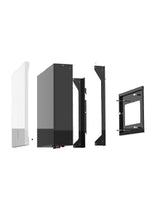 Sunsynk Battery Wall Mount Bracket
Wall-hangs the battery next to the inverter rather than standing it on the floor.
-
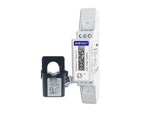 Sunsynk SDM120CT-M Single-Phase Meter
For export limiting under G100, where the DNO caps what may go back to the grid.
-
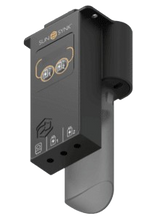 Sunsynk Klik Device
Lets two different batteries share one inverter, for topping up a stack years later.
Alternative sizes
Sunsynk make the ECCO SG04LP1 at 3, 3.6, 5 and 6 kW, all single phase on 48 V batteries and sharing this case and manual. We stock the 5 kW here and the 3.6 kW.
-
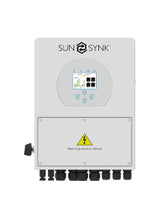 Sunsynk 3.6kW ECCO Hybrid Inverter
Smaller output but a larger 7 kWp array, and the only ECCO that stays inside G98.
In the newer Acure range the equivalents are the Acure 5.0 kW, with a built-in logger and arc-fault detection, and the Acure 8.0 kW where 5 kW is not enough.
Questions on the 5kW ECCO
Two separate output circuits. The essential one keeps running on battery and solar through a power cut; the non-essential one drops out. Your electrician decides at install which circuits go where.
Sunsynk rate the 3.6 kW to 7 kWp and this one to 6.5 kWp. The smaller inverter is designed to be heavily over-sized on the DC side so it can charge a battery while exporting its limit. If the roof is big and the grid connection is small, the 3.6 kW is often the better fit.
Yes. The data logger is in the box along with the CT clamp and battery temperature sensor, so monitoring in Sunsynk Cloud needs nothing extra.
Yes, on or off grid, switching automatically when the mains fails. Off-grid output is capped at 5 kW continuous, twice that for 10 seconds.
Up to 16 to a single inverter, and up to 16 inverters can be paralleled on matching firmware.
An electrician working to BS 7671. The G99 application has to be approved by the network operator before the installation goes ahead.
Electrical
| Rated Power (Pmax) | 5,000 W |
|---|---|
| Module Efficiency | 97.60 % |
| Battery Voltage | 40 - 60 V |
| MPPT Quantity | 2 |
| Min MPPT Voltage | 150 V |
| Max MPPT Voltage | 425 V |
| Max Input Voltage | 500 V |
| Max DC Power | 6,500 W |
| Max AC Power (5 min) | 5,500 W |
| Max DC Current | 13 + 13 A |
| Max DC Inputs | 2 |
| Integrated DC Switch | Yes |
Mechanical
| Height | 433 mm |
|---|---|
| Width | 330 mm |
| Depth | 238 mm |
| Weight | 14 kg |
| IP Rating | IP65 |
Operating conditions
| Operating Temperature | -45 °C to +60 °C, derating above +45 °C |
|---|
Warranty
| Warranty | 5 years |
|---|
- Application Note Eastron 1 phase meter with Sunsynk inverter
- CE Declaration of Conformity Sunsynk - Battery-Compatibility - V14_En
- Data Sheet Sunsynk_Ecco_SG04LP1
- EN50549 SG04LP1_EN-50549-1_CoC_SunSynk-Ltd
- G100 certification G100-V2 Procedure & Registration Instructions
- G100 certification Product decleration
- G99 Certificate Manufacturers decleration Cyber Security
- G99 Certificate SUN-(5.0 - 8.0)-ECCO
- User Manual Sunsynk Ecco 5 manual v23 EN
- Warranty SUN-5.0-ECCO
Most orders are delivered the next working day, subject to the delivery method, product availability, order processing time and destination. Next-working-day delivery is typical for standard deliveries and is not guaranteed for every order.
Pallet deliveries may take an additional day or so, depending on the products ordered, the delivery location and the carrier’s schedule. Special delivery arrangements may also require additional time.
Please refer to your tracking information for the latest delivery updates.
