Solis Flexcore ID Battery Control Box
- Secure Checkout
- Tracked Delivery
Solis Flexcore ID Battery Control Box
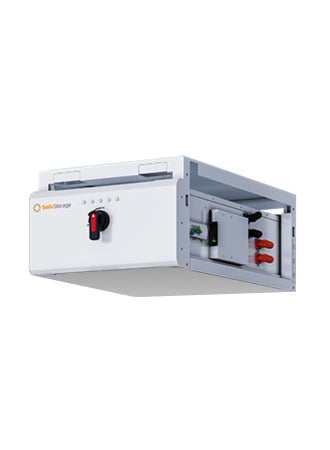
Every FlexCore-ID battery cluster is run from one FlexCore-ID-CB250A high-voltage control box. Rated 1000 V and 250 A, it joins the series string of packs to the inverter through its own breakers and contactors, and houses the battery management and a cloud gateway.
The box weighs 50 kg and matches the 532 mm width of a FlexCore-ID pack, so it stacks as the top layer of a column. Solis lists one with every system size from 60 kWh to 261 kWh.
The CB250A in figures
What the control box does
The packs of a cluster connect end to end, and the string's two ends terminate on the box's B+ and B- terminals. Facing the inverter it has two pairs of PCS terminals, P1 and P2, and a dedicated CAN port, JP6. A cluster breaker isolates the string, while two further breakers feed the box's DC/DC and AC/DC power supplies.
It also sends 24 V down the stack for the management unit and fans in each pack, carries CAN through the daisy-chained pack cables and assigns each pack its address. A green lamp shows the high-voltage bus is energised; a red one signals an alarm.
Monitoring, data and remote access
A gateway built into the box saves a CSV record of BMS data every 5 seconds and holds no less than 365 days of history, exportable through its web interface. It reports to Solis's Ginlong Cloud, pushing alarms as they occur and cluster and cell data once a minute by default.
For its uplink the gateway can use a wired network, Wi-Fi in station mode, or 4G, and the 4G route accepts a 15 × 12 mm Micro SIM only. Out of the box its Wi-Fi runs as an access point, so the commissioning engineer can open the local web pages from a phone. Gateway and BMS firmware can be upgraded remotely.
One box per cluster, and running clusters in parallel
The box count always equals the cluster count. With several clusters, the boxes are daisy-chained on the DC side, P2 of one to P1 of the next, while the first box's P1 and the last box's P2 go to the inverter's BAT1 and BAT2 inputs. Each box's JP4 port links to the next for parallel CAN and cluster addressing.
Start-up follows the same chain. The box holding the inverter communication powers up first, the rest follow in communication order, and the cluster quantity is entered in the inverter app before the cluster breakers close.
Siting and wiring the box
Sitting at the top of a column, the box shares the cluster's conditions: indoors, IP20, in a fireproof room with its own fire alarm and extinguishing equipment. Its manual switch goes to off before any pack is installed.
The DC leads to the inverter are made up on site, 25 mm² for clusters of 3–9 packs and 35 mm² for 10–13. For the inverter CAN link Solis recommends 0.35 mm² cable, no longer than 18 m. With the S6-EH3P125K10-NV-YD-H inverter, one phase of its backup output also feeds the box's AC220 input on JP5.
In the box
- 1 × FlexCore-ID-CB250A high-voltage control box, 1000 V/250 A
- 1 × cover for the box and its cables
- 1 × 4G antenna
- 1 × Wi-Fi antenna, 2.4 GHz
- 1 × JP3 port plug, packed with the box
- 1 × JP4 port plug, pre-fitted, for parallel-cluster communication
- 1 × JP5 port plug, pre-fitted, for the AC input
- Battery packs: three to thirteen per box
- The accessory kit, with the box-to-pack communication cable and main cluster leads
- DC leads to the inverter (25 or 35 mm²) and the CAN cable
- A Micro SIM, if the 4G link is used
Order alongside
-
 Solis FlexCore-ID 20 kWh stackable battery
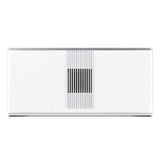
The 20.09 kWh, 64 V LiFePO4 pack this box manages. Each cluster takes 3 to 13 of them in series beneath the box.
-
 Solis FlexCore-ID accessory kit for 3–4 batteries
For a cluster in one column, with the 190 mm lead from the box to the first pack.
-
 Solis FlexCore-ID accessory kit for 5–9 batteries
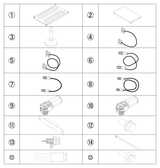
For five to nine packs over two columns, with the lower jumper leads that join the columns.
-
 Solis FlexCore-ID accessory kit for 10–13 batteries
For ten to thirteen packs over three columns, with both upper and lower jumpers between them.


Questions on the FlexCore-ID control box
No. Each cluster has its own box, and parallel clusters are linked box to box, up to six in all.
Solis's system range ends at 13 packs, 261 kWh. Beyond that, add a second cluster with its own box and its own battery packs.
That is the box's maximum. Solis recommends 157 A for charging and discharging a cluster, with 173 A as the pack maximum in the manual.
The box keeps at least a year of data locally and serves it over its own web pages. Cloud reporting and over-the-air upgrades need the wired, Wi-Fi or 4G uplink.
A Windows 10 or 11 laptop, a 2 m network cable and staff trained on the BMS, gateway and inverter, who set the cluster serial number, installed capacity and power in the gateway's web interface.
- -- EN62477 Solis FlexCore-ID - EN
- -- IEC61000 Solis FlexCore-ID - EN
- -- IEC62619 Solis FlexCore-ID - EN
- -- IEC62619 Solis FlexCore-ID - EN DE (English, German)
- -- IEC63056 Solis FlexCore-ID - EN
- -- Test report IEC60730 Solis FlexCore-ID - EN (English, German)
- Data Sheet Solis Flexcore-ID - EN
- User Manual Solis FlexCore-ID - EN
Most orders are delivered the next working day, subject to the delivery method, product availability, order processing time and destination. Next-working-day delivery is typical for standard deliveries and is not guaranteed for every order.
Pallet deliveries may take an additional day or so, depending on the products ordered, the delivery location and the carrier’s schedule. Special delivery arrangements may also require additional time.
Please refer to your tracking information for the latest delivery updates.