
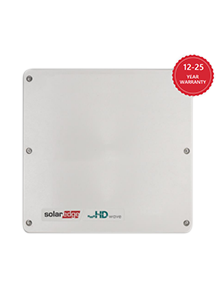
SolarEdge 10,000W Home Wave Inverter - Single Phase (Pack of 3)
10,000W Home Wave Inverter - Single Phase (Pack of 3)
SolarEdge Home Wave Single Phase, 8 – 10 kW — The single-phase ceiling: 10 kW AC, 20 kW DC, 99 % weighted.
This listing is a pack of 3 of this inverter, priced for installers buying in volume. Everything below describes the unit itself.
Please read before ordering
About the SolarEdge Home Wave Single Phase, 8 – 10 kW
This is the top of SolarEdge's single-phase Home Wave range for the UK, and it exists for houses whose electrical demand has outgrown a conventional domestic array — a heat pump, two EVs, a home office, or simply a very large roof.
The specification that stands out is DC oversizing: 20,000 W of modules on a 10,000 W inverter. Because SolarEdge optimisers present a fixed voltage, that 200 % ratio is a supported design rather than an overload, and in UK light conditions the array spends almost all of its year below the clipping threshold anyway. You harvest far more in spring and autumn and lose a handful of hours at midsummer.
European weighted efficiency is 99 %, which is about as good as grid-tied conversion gets, and it comes with the same module-level monitoring, SafeDC shutdown and integrated arc-fault protection as the rest of the range.
String design, certification and what is in the box
The details that decide whether this unit suits the job:
- Requires SolarEdge power optimisers on every module.
- Three MC4 pairs on the DC side. Nominal DC input 400 V, maximum 480 V.
- 45.5 A continuous output at 10 kW — check the consumer unit, the tails and the DNO position before you commit.
- This will be a G99 application on a single-phase supply, not a G98 notification.
- Certified to G83/1, G83/2 and G59/3 on the datasheet; check current G98/G99 documentation for your application.
- 360 × 370 × 185 mm, 16.5 kg, IP65, natural convection, under 50 dBA.
Where this inverter earns its place
The Home Wave Single Phase, 8 – 10 kW is specified most often for these jobs.
Can I add a battery to this?
This inverter has a battery port. It takes Compatible with SolarEdge Energy Bank, subject to inverter firmware support.
SolarEdge SE10000H technical data
Ordered with this inverter more often than anything else
An inverter on its own rarely completes the job. These are the parts our customers add most often:
Questions we get asked about this inverter
Can I really put 20 kW of panels on a 10 kW inverter?
Yes, that is the datasheet figure. In UK conditions an array rarely reaches its STC rating, so the clipping loss is small and the gains on dull days are large. Model it before committing, but do not be put off by the ratio.
Will the DNO allow 10 kW on single phase?
It is a G99 application and the answer is network-specific. Many will approve it with an export limit. Apply early.
Do I need optimisers?
Yes, on every module. This is not a conventional string inverter.
Battery?
The datasheet lists the SolarEdge Energy Bank, subject to inverter firmware support. If storage is the goal from day one, the Home Hub inverter is the purpose-built choice — ask us and we will check your part number.
Documents, advice and trade pricing
Every datasheet, certificate, installation manual and warranty document we hold for this product is in the Documents tab below. See the rest of our inverter range and our solar panels, or email our sales team at sales@clearraysolar.com if you would like us to check a string design or a compatibility question before you order.
Three figures govern it, all in the Technical Specifications: the MPPT voltage range, the maximum input voltage and the maximum DC power. Tell us which panel you're pairing it with and we'll confirm the string layout.
G98 covers installations up to 3.68kW per phase and is notified to your DNO after commissioning. Anything larger needs G99 approval agreed beforehand. We can flag which one your design falls under.
A hybrid inverter takes a DC-coupled battery directly. A standard string inverter needs an AC-coupled battery alongside it. The Technical Specifications show which type this unit is.
Yes, up to the maximum DC power figure in the specifications. Modest oversizing is normal practice - it lifts output in winter and at either end of the day, at the cost of brief clipping at midday peak.
An MPPT tracks the optimum operating point for a string of panels. You want one per roof orientation or pitch, because panels facing different directions on a single tracker drag each other down.
The standard manufacturer warranty is listed under the Warranty tab. Extended cover is available on most brands - see Warranty Extensions.
Build your complete solar system
Everything you need in one place.
- Inverters
- Batteries
- Mounting Systems
- Cabling & Accessories
- Protection Devices
Delivery times vary by region:
- UK — 1-2 business days
- Highlands & Islands — 1-2 business days
Returns accepted within 14 days of delivery for unused items in original packaging.


