Dyness Powerbrick Plus 16.07kWh Battery
- Secure Checkout
- Tracked Delivery
Dyness Powerbrick Plus 16.07kWh Battery
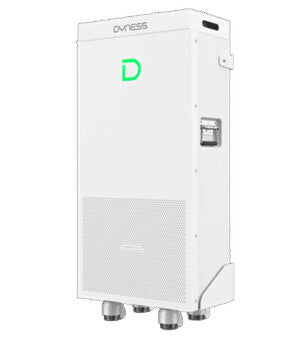
The Dyness PowerBrick Plus packs 16.07 kWh into one low-voltage home battery, built on 314 Ah lithium iron phosphate cells at a nominal 51.2 V. Usable energy is 15.27 kWh at 95% depth of discharge, and it charges or discharges at up to 200 A, or 10.24 kW.
Its IP65 cabinet stands on the floor or hangs on a wall, indoors or out, with an aerosol extinguisher inside. Up to fifty can run in parallel, from 16 kWh to 803 kWh, under a ten-year Dyness warranty when linked to the inverter.
The PowerBrick Plus in figures
Cells, current and cold weather
Dyness recommends 0.5C, 157 A or 8.03 kW, for everyday cycling and sets 0.64C (200 A) as the ceiling both ways, with a 300 A peak for two minutes at 25 °C. The cycle rating of 8,000 or more is measured at 0.2C and 95% depth of discharge, down to 70% of original capacity.
The standard cabinet charges between 0 and 55 °C. An optional self-heating version, marked by its own heating label, charges down to −20 °C; both discharge from −20 to 55 °C.
Fire suppression and BMS protection
The aerosol extinguisher is designed to detect and put out a fire within five seconds. Dyness's own BMS balances every cell and guards against over-charge, over-discharge, over-current and abnormal temperature: above 210 A of charge it throttles current to 5 A or less, and above 305 A of discharge it sounds the buzzer and cuts output. A front LED flashes green on standby, yellow for a communication fault and shows steady red when a protection trips.
Inverters Dyness lists for it
The datasheet names Solis, GoodWe, Growatt, SMA, Victron, Deye and APsystems; the manual's DIP switch table adds more. GoodWe, Solis, TBB, SAJ and SolaX run on the factory setting. SMA, Victron, Ingeteam, Solplanet, SOFAR, Deye, Hoymiles, APsystems, LuxPower, MUST, SOSEN and Afore need switch #3 on the master turned ON. Growatt SPH/SPA over CAN, Axpert King, VMIII and MAX, and InfiniSolar use switch #2; Growatt SPF HVM-P, ES and WPV on RS485 use #2 and #3; Schneider Conext uses #1 and #3. Slaves keep the factory setting, and Dyness's own compatibility list has the final say.
The manual matches one cabinet to a 5 kW or 10 kW hybrid or off-grid inverter and two to a 15 kW model, with inverter settings of 57.6 V bulk, 56.5 V absorption, 56 V float and a 48 V or 5% SOC cut-off.
Siting, mounting and parallel banks
- Location: shaded from sun, wind and rain, away from sea air, conductive dust, corrosive gas and flammables, ideally at 15–30 °C, with a dry powder extinguisher close by.
- Wall: solid brick or concrete of 100 mm or more, leaving over 300 mm clear at each side.
- Floor standing: the cabinet's top still bolts to a wall support bracket, about 15 mm off the surface, on M6 expansion bolts at 6 Nm.
- Wall hung: the template's lower edge goes roughly 300 mm above the floor; the cabinet sits on a bottom bracket, bolted top and bottom.
- Moving it: at 119 kg it can be wheeled by one person on the optional regulating wheels, slowly and upright.
- Parallel: each unit runs its own pair of power cables to a distribution box; past twelve units, the 120 Ω resistor fits the last battery's CAN OUT port.
In the box
- 1 × PowerBrick Plus battery, 51.2 V / 314 Ah
- 1 × red positive power cable, 50 mm², 2,050 mm
- 1 × black negative power cable, 50 mm², 2,050 mm
- 1 × battery-to-inverter communication cable, 2,000 mm, RJ45 at both ends
- 1 × parallel communication cable, 2,000 mm, RJ45 at both ends
- 1 × earth wire, 6 mm², 500 mm
- 1 × 120 Ω CAN resistor
- 3 × M6 × 14 combination screws
- 6 × M6 × 80 expansion bolts
- 1 × positioning template
- 1 pair of battery brackets and 2 fixing brackets
- 1 × unlock piece
- User manual, letter to customer, warranty card and packing list
- Top cover and the four regulating wheels: listed as optional, so check whether the configuration supplied includes them
- M6 OT terminal for the earth connection, which the manual leaves to the installer
- The distribution box for a parallel bank, and the inverter
Warranty: ten years, with conditions
Cover runs ten years from installation or 180 days after dispatch from Dyness, whichever is earlier, and guarantees 70% of usable energy over that time or 47.375 MWh of throughput, whichever comes first. Without a communication link the battery cannot protect itself from deep charge or discharge, so the term drops to three years. Accessories, an incompatible inverter, relocation without Dyness's written consent and transport outside the original packaging all fall outside cover.
Questions on the PowerBrick Plus
Yes, it is IP65, though the manual still wants it out of direct sun, wind and rain, on level ground.
Where the cabinet must charge below freezing, yes. The standard model stops charging under 0 °C but keeps discharging to −20 °C.
Divide the maximum current the inverter shows by one module's maximum. If the result equals the number of cabinets, the link is good.
No. Dyness rules out mixing makers, models, or old and new units.
Between −10 and 35 °C, recharged above 80% every six months.
Electrical
| Battery Type | Lithium Ion |
|---|---|
| Nominal Energy | 16070 Wh |
| Depth of Discharge | 95.00 % |
| Battery Voltage | 51 V |
| Continuous Discharge Rate | 8030 W |
| Max Discharge Rate (5 min) | 10240 W |
| Surge Discharge Rate (15 sec) | 10240 W |
| Max Charge Rate (5 min) | 10240 W |
- -- Dyness PowerBrick Plus EN
- Data Sheet Dyness PowerBrick Plus
- Independant Test Report Dyness PowerBrick Plus EMC Conformity EN
- Independant Test Report Dyness PowerBrick Plus RED EN
- Independant Test Report Dyness PowerBrick Plus SDS EN
- Safety Transport & Handling Documentation Dyness PowerBrick Plus Dangerous Goods EN
- Test Certificate IEC62619 Dyness PowerBrick Plus/SC/Max EN
- Test Certificate IEC63056 PowerBrick Plus EN
- User Manual Dyness PowerBrick Plus
- Warranty Dyness PowerBrick Plus EN
Most orders are delivered the next working day, subject to the delivery method, product availability, order processing time and destination. Next-working-day delivery is typical for standard deliveries and is not guaranteed for every order.
Pallet deliveries may take an additional day or so, depending on the products ordered, the delivery location and the carrier’s schedule. Special delivery arrangements may also require additional time.
Please refer to your tracking information for the latest delivery updates.